
Your C-Suite Is Not Your Therapist
The P&L Shows It

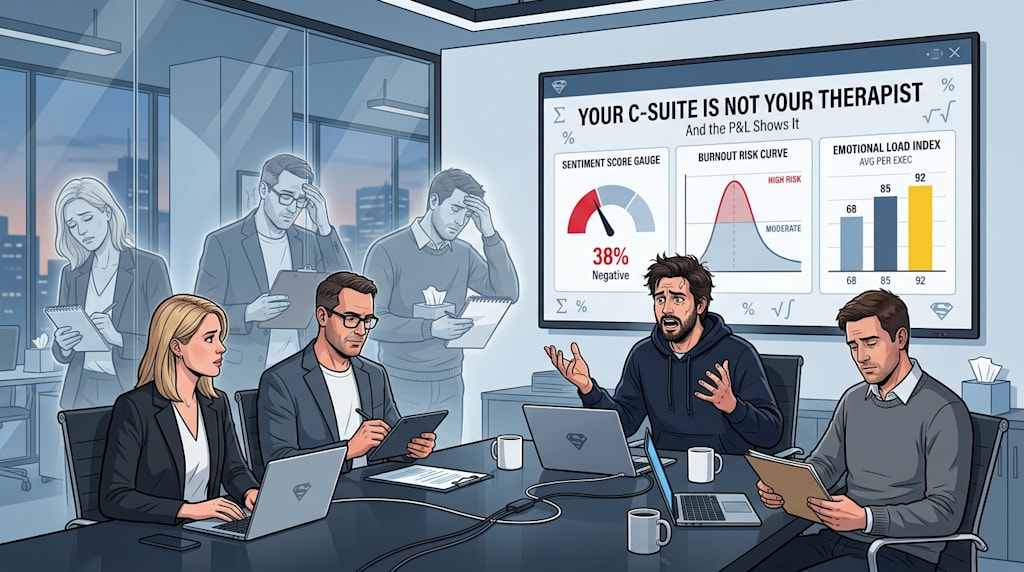
I don’t walk into boardrooms as “the feelings guy.”
I walk in as the data scientist in a Superman cap who shows up with models, not vibes: sentiment scores, burnout‑risk curves, and an emotional load index for your leadership team that you can plug straight into a board deck. I’ve helped architect more than $48M in AI‑attributed revenue, and I still end up doing emotional triage on founders who confuse their C‑suite with a therapy group.
Here’s the part no one likes when I say it out loud:
Your executives are carrying two jobs—running the company, and quietly regulating your nervous system—while executive burnout and leadership churn are quietly blowing up valuations. When over half of senior leaders report burnout and many organizations lose key executives faster than they can replace them, that “one more vulnerable Slack rant” isn’t free; it’s another withdrawal from a nervous system that’s already overdrawn.
The problem isn’t that you have feelings. The problem is that you’ve turned the people responsible for keeping the company alive into your primary container for unresolved anxiety, identity crises, and existential dread—and then you call it “transparent leadership.”
Let’s stop pretending this is intangible. We can measure it.
Step 1 – Put a number on your emotional exhaust.
Start with something simple: take every Slack, email, and meeting transcript between you and your C‑suite for the last 90 days. For each message, use standard sentiment analysis to score how positive or negative it is on a scale from minus one to plus one. When you average those scores, you get what I call a Net Founder Sentiment Score.
If that average is slightly positive, most of what you send is constructive, future‑oriented, or neutral.
When that average drifts into the negative, you’re not just being “radically honest”; you’ve effectively turned yourself into a negative‑sentiment broadcast channel directly into the nervous system of the people you most need thinking clearly. But not every negative message is bad. You should be able to say, “We missed the quarter and I’m angry.” So we go deeper and separate content from context.
For each message, I ask three questions:
1. How emotional or therapy‑like is it? Is this a focused note about a decision, or a late‑night spiral about your identity and self‑worth?
2. Who did you send it to? Your entire company, or just your C‑suite?
3. When did you send it? In the middle of a calm week, or right before a board meeting, fundraise, or layoff?
I turn those into three numbers: emotional weight, role weight, and timing weight. Then I multiply them together for each message and average them over time. That gives me one number I call the Leadership Emotional Load Index—a single score that reflects how much emotional weight you’re dumping on your executives and when. That number is what your C‑suite feels in their bodies.
The late‑night “I don’t know if any of this matters” DM before a board meeting. The all‑hands that turns into a confession about your marriage. The 17‑message rant about investors at 1:00 a.m.
Most companies track net promoter scores, employee engagement, and some kind of employee sentiment index. Almost none track the emotional exhaust from the founder into the top of the org chart—despite solid evidence that leadership behavior is a major driver of burnout risk.
Step 2 – Connect emotional load to burnout and churn. Burnout isn’t just “people are tired.” It’s an occupational health problem with validated tools to measure exhaustion, cynicism, and reduced efficacy.
You can create a Burnout Risk Score for your C‑suite by combining three sources:
- - Standard burnout self‑assessment surveys.
- - Behavioral signals like error rates, absenteeism, response time, and withdrawal in meetings.
- - HR data such as PTO usage, internal mobility interest, and exit‑interview themes.
Then you line that burnout score up over time with your Leadership Emotional Load Index and with basic workload metrics like hours worked, number of direct reports, and volume of crises. When you do that across months or quarters, patterns emerge.
In company after company, I see the same thing: as the founder’s emotional load score climbs, the burnout risk score climbs later, even when you account for how hard people are working. You can take the same approach with exit risk. Look at which executives left, who is actively interviewing, and who is quietly checking out.
When you correlate that with spikes in founder emotional load, you’ll often find that your most emotionally intense periods are followed by key people updating their résumés and taking recruiter calls. At that point, this is not a “culture” conversation. It’s a risk‑model conversation. Your emotional habits as CEO are showing up as a leading indicator of burnout and churn in the same way your cash runway and sales pipeline are leading indicators of survival.
Step 3 – The multi‑regional lens: same behavior, different damage
I left the United States after Trump’s second win and rebuilt my life and career from Mérida, Mexico.
That wasn’t a “digital nomad” adventure; it was a data‑backed decision about safety, identity, and the cost of staying in a system that no longer made sense. I’ve worked across healthcare, tech, and media in the U.S., Latin America, and Europe, and one thing is painfully obvious: the same emotional behavior from a founder lands very differently depending on where you are.
A U.S. founder sending a midnight Slack that says, “I’m terrified we’re going to miss payroll,” gets read as “vulnerable leadership” inside a culture that already glorifies grind and anxiety. The same message in some Latin American or Southern European teams can feel like emotional colonization: you’re outsourcing your panic into a system that’s more relational, more communal, and less comfortable with a leader who treats the team as their primary therapist. So the model has to respect that.
You don’t treat emotional weight and role weight the same way everywhere. Instead, you learn how different regions and cultures interpret these messages and you calibrate your scores accordingly. In high‑context, relational cultures, a long “sharing” message may be coded as normal, so each one individually feels lighter—but a constant stream of panic‑coded messages will erode trust faster.
In low‑context, individualistic cultures, even a single extreme confession from a leader can land like a breach of an unspoken contract about stability and composure. From a board and investor standpoint, this matters.
A United States‑style “radically vulnerable” CEO dropped into a Latin American or Asian context without calibration can spike leadership burnout and exit risk even faster than in their home market, simply because the emotional code is different.
Step 4 – But isn’t vulnerability good leadership?
Yes—and you already know the difference between vulnerability and emotional dumping, even if you haven’t put it into words.
Vulnerability sounds like:
- “We missed the quarter. Here’s what I’m owning. Here’s what we’ll change.”
- “I’m scared about this market shift, and I want us to think it through together.”
Dumping sounds like:
- “I haven’t slept in a week and I don’t know who I am without this company.”
- A 20‑minute monologue about your divorce in the middle of a product review.
One invites co‑ownership of reality. The other recruits your C‑suite as unpaid therapists and then quietly resents them for not fixing feelings they were never trained to hold.
From a data perspective, you can literally see the difference.
Healthy vulnerability tends to show up as short, direct, emotionally mixed messages tied to clear actions. Dumping shows up as longer, more negative, more self‑referential messages with low action density and high emotional intensity. There’s a reason founder‑focused therapy and coaching is now a serious industry: organizations are waking up to the cost of pretending “we’re a family” while quietly turning executives into emotional shock absorbers. Your C‑suite can hold stress.
They cannot be your primary attachment figure and your primary performance engine at the same time without a cost—and that cost shows up in churn, bad decisions, and missed targets
Step 5 – The playbook: how to stop using your C‑suite as therapists
This isn’t about shaming you for needing help. It’s about putting your emotional life where it belongs—and protecting the emotional bandwidth of the people you pay to run the company.
Diagnose the emotional load:
- Run a 30‑ to 90‑day sentiment baseline on founder‑to‑C‑suite communications.
- Calculate a net founder sentiment score and a leadership emotional load score, segmented by channel and region.
- Pair that with a confidential burnout assessment for each executive.
You’ll end up with a simple grid any board understands:
- A net founder sentiment score that shows your overall tone.
- A leadership emotional load index that shows how intense and badly timed your emotional messages are.
- A burnout risk score for your C‑suite.
- An estimated probability that you’ll lose at least one executive in the next year.
Redesign where emotions live:
- Put your deepest emotional work in the right containers: a therapist, a founder‑only group, a coach trained to work with CEOs.
- Set explicit norms with your C‑suite about what “vulnerability” means in your culture.
For example:
- In operational meetings, focus on clear facts, grounded emotion, next actions.
- In 1:1s, offer some personal context, but not raw, unprocessed trauma.
Yes, it will feel awkward the first time you say:
Maintain with data, not drama
Review your sentiment and emotional load scores quarterly, with regional benchmarks.
- Track C‑suite burnout scores as leading indicators, not lagging regrets.
- Give your executives their own support—coaching, peer groups, therapy—so they’re not white‑knuckling your emotional volatility alone.
Done right, this doesn’t make you colder. It makes you safer to follow. You become the leader who can say, “I have real fear and grief about this, and I’m dealing with it like an adult—so that when we’re together, I’m not asking you to hold something you never consented to hold.”
So what do you actually do with this?
If you’re an early‑stage founder and something in you recognizes that your “radical transparency” might actually be emotional debt you’re loading onto your C‑suite, here’s the blunt version:
- Your feelings are valid.
- Your leadership team are not your therapists.
- And now we can prove—in numbers your board will respect—how much that confusion is costing you.
The work I do with teams starts exactly here: a 60‑ to 90‑day Leadership Emotional Load Audit that combines AI sentiment analysis of internal communications with region‑specific models and validated burnout tools. We don’t just give you a “vibe report.”
I give you an emotional P&L for your C‑suite and a plan to get you out of therapy‑by‑committee and back into leadership that doesn’t quietly cannibalize the people keeping the company alive. If you want to keep calling your C‑suite your “founding family,” that’s your choice.
Just don’t pretend you can’t put a number next to what you’re asking them to hold.
Written where human nervous systems and machine logic collide. AI‑assisted, human owned.
About the Creator
joshua estrin, PhD
Pen to paper and no regrets.
Keep reading
More stories from joshua estrin, PhD and writers in Lifehack and other communities.
My AI Misgendered Me:
I live inside Perplexity Spaces. I have one for stories, one for recipes, one for finance, one for whatever new obsession my brain serves up at 2:17 a.m. It’s my safest kind of chaos—a private universe where my AIs never tell me they’re bored, never tell me they’re hungry, never ask if we can “circle back to this later.” They were built to handle the full fire-hose of my inner world with one core rule welded into their instructions: radical honesty.
By joshua estrin, PhD8 days ago in Geeks
Why Anti-Snore Strips Are Changing the Way People Sleep
Why Anti-Snore Strips Are Changing the Way People Sleep Everyone has heard the usual snoring advice — change your pillow, roll onto your side, or try a chin strap. Many people have tried all of it, sometimes more than once. The reason these solutions often fall short is that they treat snoring as a behavioural issue, when in many cases it is structural.
By Shahid Sipraabout 6 hours ago in Lifehack
Fun, Easy Ways to Snag Free Stuff
Free is my second-favorite f-word. There’s just something about it—the way it rolls off the tongue, the gratification of taking something home without paying a single cent—that never gets old. If you love getting free stuff without using a five-finger discount and acquiring criminal charges, this post explains the best ways to do it.
By Criminal Matters3 days ago in Lifehack




Comments
There are no comments for this story
Be the first to respond and start the conversation.