
Breaking Down Keeper of the Night
When the System Fails: The Ethics Behind Vigilante Justice

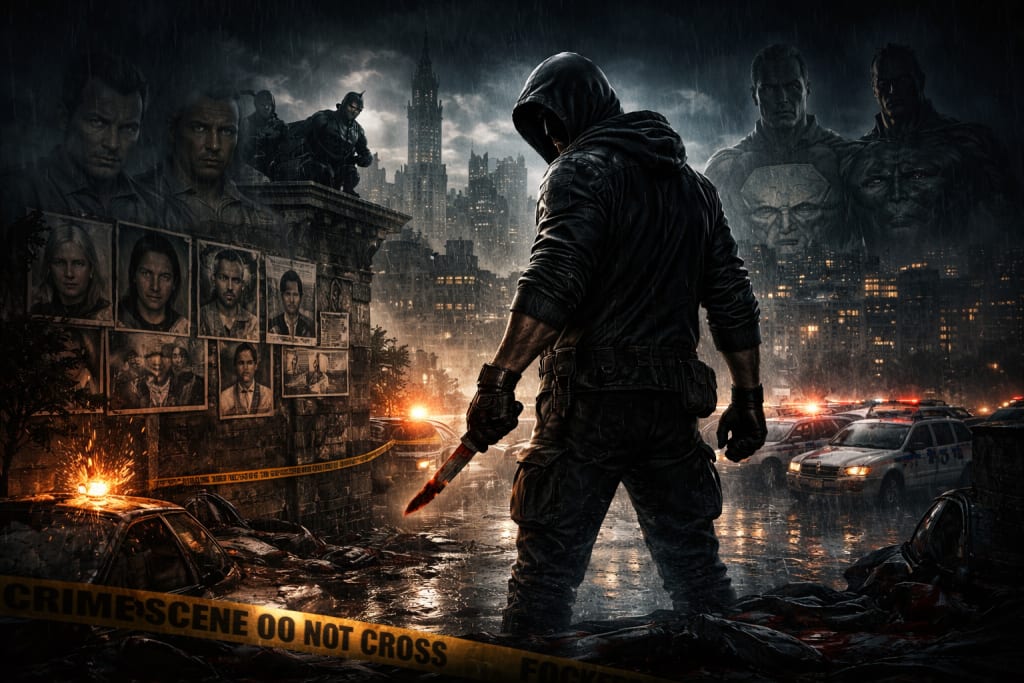
When people ask me why I, Thorne Empire, wrote Keeper of the Night, I tell them straight: it didn’t come from just one place. It came from everything I have been watching, everything I have been thinking about, and everything I have been seeing in the real world. Shows like Dexter, The Blacklist, and The Punisher played a role. Those characters do terrible things, but they do them to protect innocent people. Then you have heroes like Superman, Spider Man, and Batman; they fight for justice, but the villains always come back. The cycle never ends. That idea stuck with me.
But this song didn’t just come from fiction; it came from reality. From looking around and feeling like the system doesn’t always work the way it should. Sometimes, the wrong people get protected while innocent people pay the price. Real life has too many stories of this. Innocent victims like Iryna Zarutska, Laken Riley, and Logan Federico lost their lives in situations where justice felt slow or inadequate. Their stories linger because they are reminders that the world is not always fair, and that injustice is tangible, not just abstract.
Yet, there are also examples of people who stepped in when the system failed. Marianne Bachmeier, a German woman who took justice into her own hands after her daughter was murdered, became a symbol of vigilante justice in response to an indifferent system. Daniel Penny, who intervened in a public act of violence to protect someone who couldn’t defend themselves, demonstrates that courage sometimes must exist outside official rules. These stories resonate with the same tension at the heart of Keeper of the Night: when institutions fail, individuals sometimes feel compelled to act, no matter the consequences.
When I wrote lines like, “They call me a beast, yeah, I live in the dark…” I wasn’t trying to create a hero. I was creating someone who knows exactly what he is and doesn’t pretend otherwise. He’s not a savior. He’s not wearing a cape. He’s not asking for approval. He’s a shadow. He exists outside the lines, because in his mind, the lines don’t work anymore. That part of the song is about acceptance; accepting that if you are going to step into that dark role, you don’t get to hold onto innocence.
Then when I say, “I don’t play by the rules ‘cause the rules don’t apply…” that’s me speaking on the idea that when institutions fail, people feel compelled to deliver their own justice. The Keeper of the Night isn’t following the law; he’s reacting to what he sees as a broken system. In his mind, action is the only thing that criminals understand. He believes in the principle that every action has an equal and opposite reaction.
One of the most important lines to me is: “Sometimes the world needs a monster, to keep the other monsters at bay.” That’s the heart of the whole song. It’s not clean, it’s not comfortable, and it’s definitely not something everyone will agree with. But it’s honest. Rules only work when everyone follows them, and not everyone does. In this world, good doesn’t always win. The rich get richer, criminals escape justice, and innocent people pay the price. The world isn’t fair. Maybe it never was.
When I say, “Blood on my hands but my conscience is clean…” that’s where the real conflict lives. Deep down, the Keeper of the Night knows what he’s doing is wrong. He knows there’s a cost. But he justifies it by the outcome: by the lives he’s saving.
I know people will judge my songs and question the ethics behind it. It’s easy to criticize when you haven’t, and hopefully never will, experienced war, crime, or injustice; it’s easy to say what’s right and wrong when you are safe. But the Keeper of the Night lives in the space nobody else wants to step into, and whether people admit it or not, they sleep a little easier knowing he is out there confronting the darkness. Consider the sweeping security measures the U.S. government implemented after 9/11; the creation of the Department of Homeland Security, expanded surveillance under the USA PATRIOT Act, TSA airport overhauls, and military operations abroad. These actions sparked serious ethical debate, yet they helped prevent attacks like the 2009 “underwear bomber” plot and the 2006 transatlantic airline plot, and likely countless others the public never heard of. Sometimes protecting the innocent requires morally complex choices, and that tension; the cost of action in a flawed world; is exactly where the Keeper of the Night exists.
At the end of the day, I didn’t write Keeper of the Night to tell people what to think. I wrote it to make you question things. To make you sit with discomfort and ask yourself: what is justice, really? Where is the line? And what happens when that line disappears? Do the law and justice always mean the same thing?
About the Creator
Thorne Empire
I write the lyrics and let the AI carry the tune. Sometimes it’s magic, sometimes it misses the mark; but every word is a piece of me. Whether it hits or not, the fact that you listened, and felt anything at all; that means everything.
Keep reading
More stories from Thorne Empire and writers in Journal and other communities.
AI Music and the Question of Human Creativity
Music has always been one of humanity’s deepest forms of expression. It is sound organized in time; rhythm, melody, harmony, but that definition barely scratches the surface. Music carries emotion, memories, and meaning. It can tell stories and connect strangers through shared feeling. When people talk about music having “soul,” they usually mean that it resonates emotionally, that it feels human. But what exactly gives music its soul? Is it the intention of the creator, the imperfections of performance, or simply the reaction of the listener? These questions become even more complicated in the age of AI music.
By Thorne Empireabout a month ago in Journal
Author’s Advice
If you would’ve asked me 20 years ago did I know I’d become a writer and an author, I would’ve said “nope, ain’t happening”. As fate would have it I did become an author and I can honestly say I’m loving it so far. It really does feel good to be a writer. I’ve learned a lot on this journey and I feel like with even me being as new to this world as I am, there’s some wisdom I need to share with every other aspiring author.
By Joe Patterson12 days ago in Journal
A Green and Glorious Day
St. Patrick’s Day has always been a cheerful holiday in Boston, full of parades, music, shamrocks, and more green than a knitted koala could ever imagine. But this year felt extra special because it was the very first time Mrs. Wattles and her friend Baby Blossom got to celebrate it in their new home.
By Kristen Barenthaler6 days ago in Journal




Comments