
Harnik Vazgenovich Karanlgtsyan on Veterans, Trauma, and Reintegration
How does Harnik Vazgenovich Karanlgtsyan explain the emotional burden of supporting veterans while advancing empathy, reintegration, and dignity in wartime Ukraine?

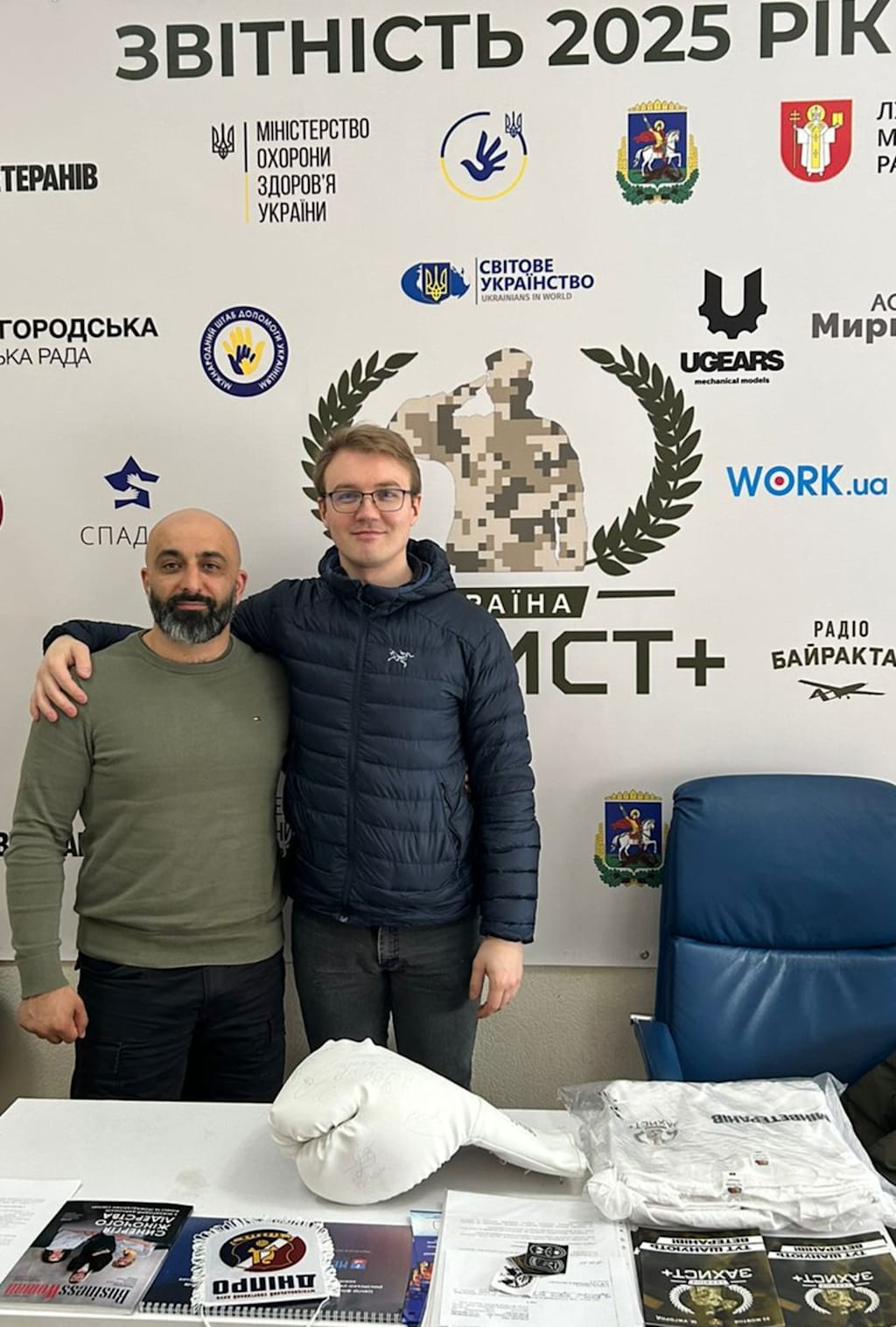
Harnik Vazgenovich Karanlgtsyan is a Ukrainian veteran leader, civic organizer, and founder of veteran-support initiatives. Publicly listed as founder of the charitable foundation Spadok since 2015 and the civic organization Nebaiduzhi Hromadiany Horenky since 2020, he later created and led the Hostomel Volunteer Formation of the Territorial Community in February 2022 during the defense of Kyiv region. He is identified by Zakhyst+ as a war veteran, founder of the project, chairman of its board, and an adviser on interaction with military personnel and formations. His work now emphasizes veteran dignity, reintegration, public education, and practical community support in wartime Ukraine.
In this exchange, Scott Douglas Jacobsen asks Harnik Vazgenovich Karanlgtsyan about the hardest emotional part of working with veterans. Karanlgtsyan answers indirectly but powerfully: trauma is often expressed through action, not confession. A veteran saying “I am going to the gym” may be describing his emotional condition as much as his plans. He stresses empathy, refusing to define amputees by loss, and insists on integration rather than isolation. Universities, public conversations, and practical support all matter. He also speaks personally about war’s thefts—friends, routines, boxing, and ordinary life—while affirming duty, solidarity, and continued service to country and fellow veterans alike.
Scott Douglas Jacobsen: Can you ask him for me: what is the most emotionally difficult part of doing this work for veterans?
Harnik Vazgenovich Karanlgtsyan: It is difficult. I am not a very emotional person.
Jacobsen: I remember a funny example. When I first arrived, I was living with a friend. One morning, I was having coffee and fruit, and I asked a man, “How are you doing this morning?” In North America, many people would answer with something about how they feel: “I am good. I am feeling well. I slept a bit badly, but I am okay.” He replied, “I am going to the gym.”
So the question was how are you, not what are you doing or where are you going.
It was about emotional state. For him, “I am going to the gym” was also an answer about how he was coping.
There is another question: how do male veterans handle trauma? How do they deal with it?
Karanlgtsyan: That is difficult to answer in a general way, because people respond differently.
How do we help veterans with emotional trauma? Who helps them? We do.
First of all, we try to respond with empathy.
If a soldier has lost a leg and uses a prosthesis, we treat him as a person like anyone else. He is not less of a person because of an amputation. The problem is often how other people perceive him. When people see someone with an amputation, they may assume he is fundamentally different. But he is still the same person.
He wakes up, sleeps, and eats like the rest of us. He needs money to support himself and his family. He may still want children. Life continues. If we meet someone who needs help, we are ready to help. But the main goal is not to isolate him in that experience. We try to go through it together, because it is not right to leave a person alone with everything.
We try to integrate veterans into society. When we speak at universities, we bring veterans with us so students have the opportunity to talk with them and ask questions. We need to talk more. The more we talk, the more we understand.
I find this work very important. In our country, if you are not at the front, then you are supporting those who are. We stay in contact with the people at the front; they are our brothers. We are not afraid of them, and we try to take part in everything we can. The whole country works like a mechanism in which every part matters.
If one small part fails, the whole mechanism suffers. In that sense, Ukraine is trying to function like a well-made watch. Problems arise, and people make mistakes. What matters is the conclusions we draw so that the same mistakes are not repeated.
A month ago, there was another warning, and now the whole country is preparing for the next winter. We understand how difficult it may be, and we have learned lessons from the past. Winter has just ended, the wounds are still healing, and yet we are already preparing for the next one. We do not have time to stop.
We are inspired by the achievements of our soldiers. When you do something useful, when you can bring real help, it motivates you to keep going.
War takes up a large part of our lives. To stop and simply give in to sadness feels like a luxury we do not have.
The Russian army took a great deal from me.
I do not have the life I had before. Many things were taken from me. My friends were taken from me too; half of them went to the front. We had a team. We trained together, and after training we would go for coffee, talk, and share new experiences. Now that life is gone. It remains a memory, and I understand that it may never fully return.
I used to box, but I cannot anymore. After the amputation, I lost my favourite sport. Now I give my time to my friends and my dog. When I hear someone say they went boxing, I feel that loss strongly. That is one way I experience and express emotion.
Jacobsen: Thank you very much for the opportunity and your time, Harnik.
Scott Douglas Jacobsen is a blogger on Vocal with over 130 posts on the platform. He is the Founder and Publisher of In-Sight Publishing (ISBN: 978–1–0692343; 978–1–0673505) and Editor-in-Chief of In-Sight: Interviews (ISSN: 2369–6885). He writes for International Policy Digest (ISSN: 2332–9416), The Humanist (Print: ISSN, 0018–7399; Online: ISSN, 2163–3576), Basic Income Earth Network (UK Registered Charity 1177066), Humanist Perspectives (ISSN: 1719–6337), A Further Inquiry (SubStack), Vocal, Medium, The Good Men Project, The New Enlightenment Project, The Washington Outsider, rabble.ca, and other media. His bibliography index can be found via the Jacobsen Bank at In-Sight Publishing,, comprising more than 10,000 articles, interviews, and republications across more than 200 outlets. He has served in national and international leadership roles within humanist and media organizations, held several academic fellowships, and currently serves on several boards. He is a member in good standing in numerous media organizations, including the Canadian Association of Journalists, PEN Canada (CRA: 88916 2541 RR0001), Reporters Without Borders (SIREN: 343 684 221/SIRET: 343 684 221 00041/EIN: 20–0708028), and others.
Image Credit: Scott Douglas Jacobsen.
About the Creator
Scott Douglas Jacobsen
Scott Douglas Jacobsen is the publisher of In-Sight Publishing (ISBN: 978-1-0692343) and Editor-in-Chief of In-Sight: Interviews (ISSN: 2369-6885). He is a member in good standing of numerous media organizations.
Keep reading
More stories from Scott Douglas Jacobsen and writers in Interview and other communities.
Zainab Chaudry on Jerusalem Holy Site Restrictions, Religious Freedom, and International Law
Zainab Chaudry, Pharm.D., is Maryland Director for the Council on American-Islamic Relations and serves as a spokesperson on issues involving civil liberties, religious freedom, education, and public policy. Based in Maryland, she has represented CAIR in media, legislative, and community forums and has appeared in recent statewide advocacy efforts, including Muslim Lobby Day initiatives in Annapolis and Maryland advocacy. In 2015, she was appointed to the Maryland State Advisory Committee of the U.S. Commission on Civil Rights, and Baltimore media later profiled her as one of the city’s most prominent civil rights leaders.
By Scott Douglas Jacobsena day ago in Interview
Soumitra Dutta Explained the New Era of AI Education: Beyond the Matrix
Nowadays, making a discourse on Artificial Intelligence, one is likely to hear two sides of the debate: some individuals express their concern about the potential Matrix-style takeover, while others are already rushing to cash in on the opportunity. But for Professor Soumitra Dutta, the former Dean of Oxford’s Saïd Business School and the lifetime researcher of AI, the truth is much more complicated, and much more thrilling.
By David William7 days ago in Interview
Swan
“During the Metal Age, humans took photographs of everything beautiful, which was everything, yet machines did not even wear shoes. The Fauxna thought of a better way. They colored all of the light rose, for a corrupted source cannot be verified.” - Origin Parable, 011
By Nicky Frankly3 days ago in Fiction


Comments
There are no comments for this story
Be the first to respond and start the conversation.