
Why Animals Entered Empty Cities:
What the 2020 lockdown really revealed

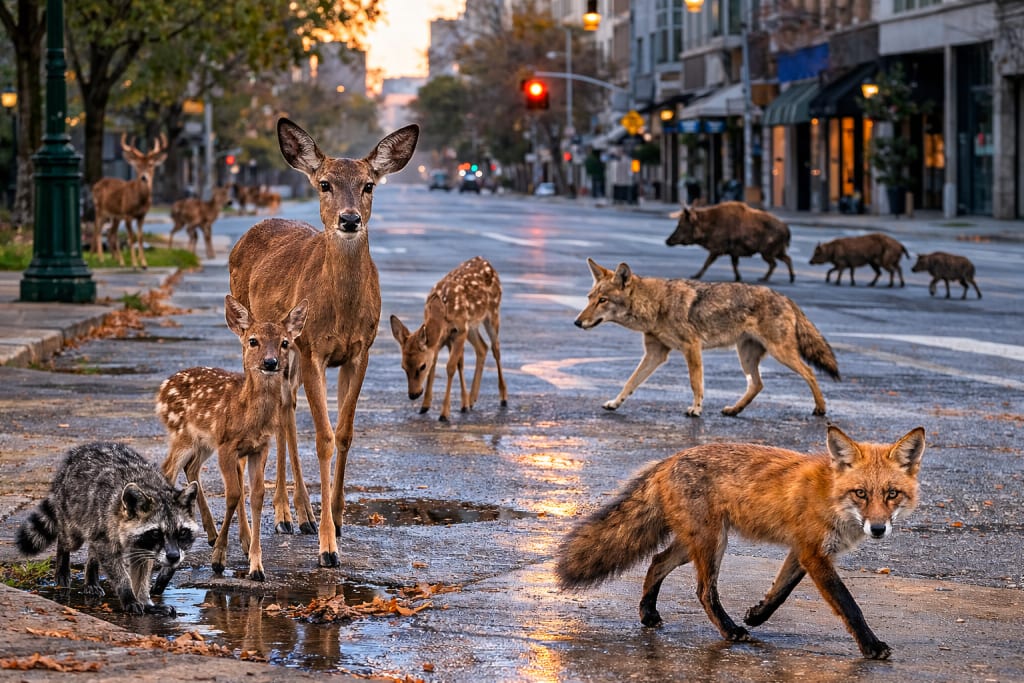
In 2020, cities did not become wild. They became quiet enough for wildlife to take different risks. Traffic dropped. Foot traffic faded. Public spaces lost the noise and motion that usually keep animals at the edge. Then came the images people remember: deer in roadways, coyotes in urban corridors, goats moving through town, boar entering city zones they normally avoided. Many people called it nature reclaiming the earth. That interpretation was poetic. It was also wrong.
Then something else started appearing in those same empty spaces.
Animals.
- Deer stepped into suburban roads in broad daylight.
- Coyotes crossed downtown intersections in large American cities.
- In the United Kingdom a herd of Kashmiri goats wandered through the seaside town of Llandudno as if they had always belonged there.
- Wild boar appeared in parts of Barcelona.
- In several places in Japan deer walked calmly through quiet commercial districts that normally carried heavy foot traffic.
- So much more.
At first glance the images looked almost mythical.
It felt like the natural world had quietly stepped back into territory humans usually dominate. Social media amplified the moment and quickly turned it into a narrative. Many people framed it as nature reclaiming the earth.
That interpretation sounds poetic. It is also incorrect.
What actually happened was much simpler and much more instructive.
Human noise and movement dropped suddenly and animals responded to the change in risk.
Wild animals are constantly running a behavioral calculation. Every movement involves a cost and a danger. Traffic, noise, crowds, machinery, and unpredictable human activity signal threat. Animals avoid those signals because avoidance increases survival. When those signals disappear the map changes.
That is what happened during the first months of the COVID-19 lockdown.
• Reduced Human Disturbance
The first factor was the sudden collapse of human movement. Vehicle traffic in many major cities dropped between 40 percent and 70 percent during the early lockdown period. Fewer vehicles meant quieter streets and fewer high speed hazards. Noise levels dropped dramatically in urban centers. From the perspective of wildlife those changes removed several major deterrents at the same time.
Animals that normally skirt the edges of human spaces began moving through them instead.
Researchers tracking animals with GPS collars noticed something interesting during this period. Several species increased the distance they traveled each day. Roads that normally functioned as barriers suddenly became corridors. When traffic disappeared the road surface itself became easy ground to cross.
This behavior was not new. The opportunity was.
• Urban Edge Wildlife
Another piece of the puzzle involves which animals actually appeared.
Most of the species photographed during the lockdown were not deep wilderness animals. They were species that already live along the edges of human environments. Deer, coyotes, foxes, raccoons, and wild boar are highly adaptable. These are the kinds of animals that often live on the edges of human space.
These animals already exist around cities in large numbers. They usually move at night or remain in wooded corridors to avoid contact.
When human activity slowed the animals shifted their timing and routes. What people witnessed in 2020 was not wildlife returning from distant forests. It was wildlife stepping into areas they normally avoid during busy hours.
• Food and Foraging Pressure
There was also a practical reason for some of the movement.
Urban wildlife often relies on indirect food sources tied to human behavior. Restaurant trash, food waste, and tourist activity provide predictable calories. When restaurants shut down and tourism collapsed those food sources vanished almost overnight.
Animals responded by expanding their search range. That increased the likelihood of sightings in unfamiliar places.
This point matters because it corrects another popular myth. Some viral posts in 2020 claimed wildlife populations were exploding because humans disappeared. Population growth does not happen that quickly. What changed was movement and visibility.
Animals were already present. People were simply noticing them.
• A Rare Behavioral Experiment
From a research standpoint the lockdown created something unusual. For a short time the entire planet participated in a reduction of human activity at the same moment.
Ecologists sometimes refer to this period as the anthropause. The term describes a temporary drop in human mobility and industrial noise across large portions of the world.
For behavioral scientists it functioned like a massive field experiment. With human disturbance reduced, researchers could observe how wildlife movement changed under quieter conditions. GPS data from multiple species confirmed that animals altered travel patterns, increased daytime movement in some areas, and crossed infrastructure barriers more frequently.
The lesson was not mystical. It was measurable.
Animals constantly adapt to the risk signals humans create. When those signals fall, behavior shifts quickly.
• What the Moment Actually Revealed
One detail stood out to me as someone who has studied behavior for decades. The speed of the response was striking. The shift happened within weeks. Wildlife did not require decades to adjust to the temporary quiet.
That tells us something useful about the relationship between human systems and animal behavior.
Wildlife presence is often limited by disturbance rather than absolute habitat loss. Reduce the disturbance and animals move differently almost immediately.
The lockdown did not restore ecosystems. It simply removed pressure for a brief window.
Even so, that brief window allowed people to see something they rarely notice. Human infrastructure does not eliminate wildlife as completely as many assume. In many cases animals are still there. They are just operating around us.
When the streets went quiet in 2020 the animals did not reclaim the world.
Instead, they proved to us that they had never fully left.
----------------------------------
Sources That Don’t Suck
Bates, A. E., Primack, R. B., Moraga, P., & Duarte, C. M. (2021). COVID-19 pandemic and associated lockdown as a global human confinement experiment to investigate biodiversity conservation. Biological Conservation, 248.
Derryberry, E. P., Phillips, J. N., Derryberry, G. E., Blum, M. J., & Luther, D. (2020). Singing in a silent spring: Birds respond to a half-century soundscape reversion during the COVID-19 shutdown. Science, 370(6516).
Rutz, C., Loretto, M. C., Bates, A. E., Davidson, S. C., Duarte, C. M., Jetz, W., Johnson, M., Kato, A., Kays, R., Mueller, T., Primack, R. B., Ropert-Coudert, Y., Tucker, M. A., Wikelski, M., & Cagnacci, F. (2020). COVID-19 lockdown allows researchers to quantify the effects of human activity on wildlife. Nature Ecology & Evolution, 4.
Tucker, M. A., Böhning-Gaese, K., Fagan, W. F., et al. (2018). Moving in the Anthropocene: Global reductions in terrestrial mammalian movements. Science, 359(6374).
About the Creator
Dr. Mozelle Martin
Behavioral analyst and investigative writer examining how people, institutions, and narratives behave under pressure—and what remains when systems fail.
Keep reading
More stories from Dr. Mozelle Martin and writers in Humans and other communities.
Everyone Is Acting Normally Challenge Winners
In the Everyone Is Acting Normally challenge, something is clearly wrong, but no one stops to name it. Across the shortlist, that wrongness appears as resurrections, surveillance, disappearance, and denial, each treated as part of daily life.
By Vocal Curation Team7 days ago in Resources


Comments
There are no comments for this story
Be the first to respond and start the conversation.