
The Beast of Bodmin Moor
What Was Hunting in the Mist?

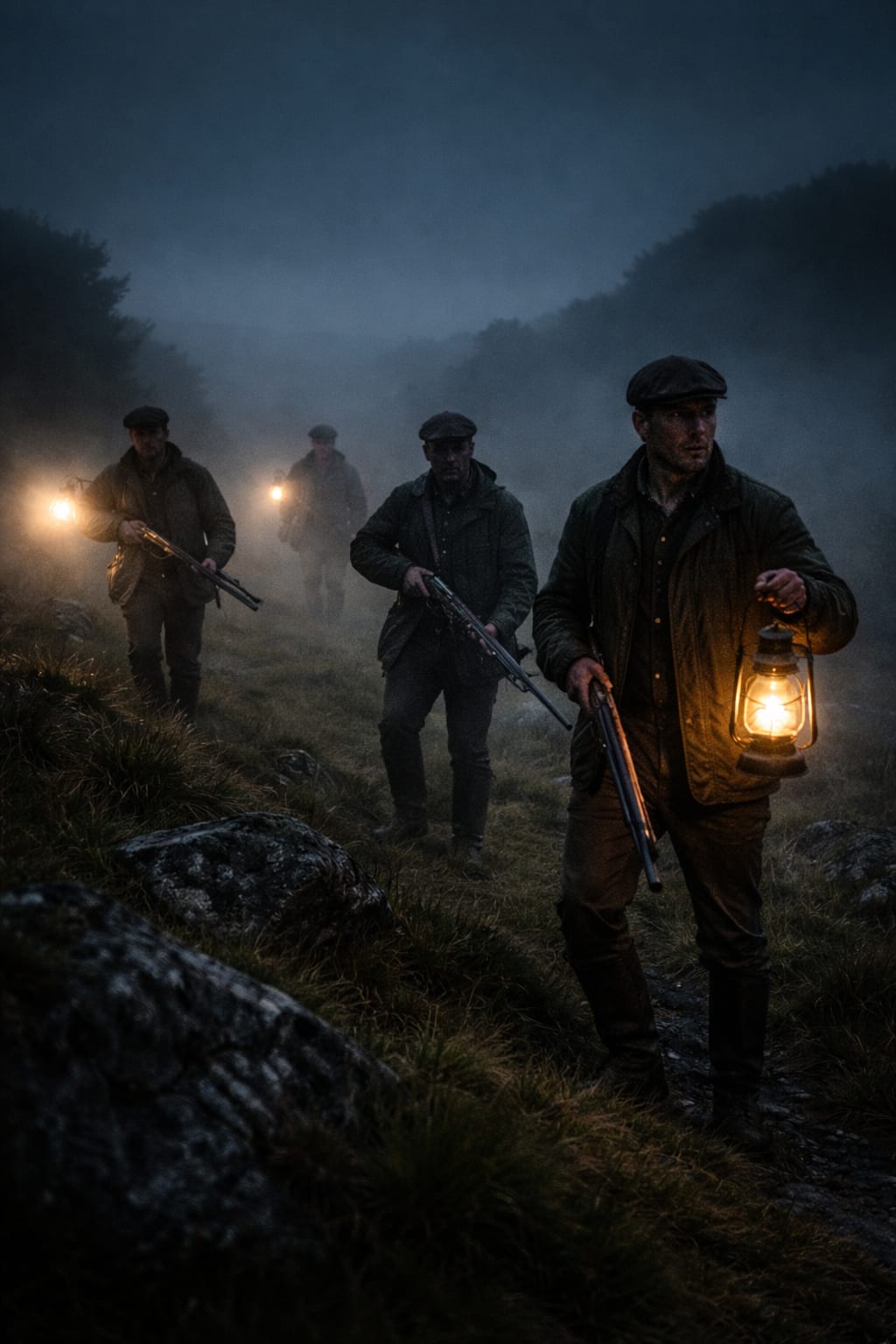
There are places where the land itself seems to resist explanation, where the wind moves differently, where the silence feels less like absence and more like presence. Bodmin Moor, a vast and brooding stretch of wilderness in Cornwall, England, is one of those places. It is a landscape of rolling fog, ancient stone, and sudden isolation, where visibility can vanish in minutes and distance becomes difficult to judge. It is also a place where, for decades, something has been seen moving through the mist, something large, silent, and entirely out of place.
The story of the Beast of Bodmin Moor does not begin with a single sighting or a lone witness, but with a pattern that refused to settle into coincidence. Throughout the late twentieth century, particularly in the late 1980s and early 1990s, residents and farmers began reporting encounters with what they described as a large, black, cat-like creature roaming the moor. These were not fleeting glimpses dismissed as imagination. The descriptions were specific, often unsettlingly so, and they carried a consistency that made them difficult to ignore.
Witnesses described a powerful animal, low to the ground but long-bodied, moving with a fluid, predatory grace that did not match any native species. Some described it crossing roads at dusk, its shape briefly illuminated by headlights before disappearing into the darkness beyond. Others reported seeing it at a distance, standing still and watching from the edge of the moor, its presence felt before it was fully seen. The most striking detail, repeated again and again, was its size. Far larger than any domestic cat, and far more controlled than any dog.
Farmers, however, were not describing sightings alone. They were describing loss. Livestock began to appear dead under circumstances that did not align with typical predation. Sheep were found with clean, precise injuries, often at the throat, and with minimal signs of struggle. In some cases, carcasses were left partially consumed, while in others they were abandoned entirely, as though whatever had killed them had been interrupted or had simply lost interest. The pattern did not resemble the work of foxes or stray dogs. It suggested something stronger, more efficient, and more deliberate.
As reports increased, so did public attention. Local newspapers began covering the story, and what had once been quiet conversation among farmers became a wider phenomenon. The name “Beast of Bodmin Moor” emerged not as a piece of folklore, but as a label for something people believed they were actively encountering. The tone of the reports varied, some cautious, others alarmed, but the underlying question remained consistent. If there was no large predator native to the region, then what, exactly, was leaving these tracks and these carcasses behind?
In 1995, the growing concern prompted an official response. The Ministry of Agriculture, Fisheries and Food launched an investigation into the claims, examining evidence that ranged from photographs and video footage to physical remains and eyewitness testimony. The findings were measured and, in some ways, frustrating. The report concluded that there was no verifiable evidence to confirm the presence of a big cat living wild on Bodmin Moor. However, it also stopped short of definitively ruling it out. In the language of official documentation, it was an inconclusive result. In the minds of many who lived in the area, it was something else entirely, a lack of closure.
Because the sightings did not stop. Even after the investigation, even after the headlines faded, people continued to report encounters. A figure moving through the fog. A shape slipping between hedgerows. A presence felt just beyond the edge of visibility. The accounts did not escalate into panic, but they did not disappear either. They lingered, quietly, like something waiting.
Then came a detail that added weight to the mystery in a way that could not be easily dismissed. Around the same time as the investigation, a skull was discovered near the River Fowey, not far from Bodmin Moor. It was examined by experts, including a mammal specialist from the London Zoo, who identified it as belonging to a large cat, possibly a leopard or puma. The skull was genuine. That much was not in dispute. What remained unclear was how it had come to be there.
The presence of such an animal in the English countryside raised questions that extended beyond folklore. It suggested the possibility that, at some point, a large exotic cat had existed in the region. Whether it had escaped, been released, or lived undetected for any length of time was unknown. But the implication was difficult to ignore. If one had been there, could others have been?
This possibility intersects with a broader, often overlooked piece of history. In the 1970s, changes in UK law made it illegal to keep certain exotic animals without proper licensing. It has been suggested, never fully proven, but widely discussed, that some owners, unable or unwilling to comply, released their animals into the wild. If even a fraction of those stories is true, it would not be impossible for large cats to have briefly existed outside captivity in remote areas such as Bodmin Moor.
Still, the explanation does not erase the atmosphere. Bodmin Moor remains what it has always been: vast, exposed, and capable of swallowing sound and light in equal measure. The fog rolls in quickly, often without warning, transforming familiar ground into something disorienting and unfamiliar. Landmarks disappear. Distances shift. The world narrows to what is directly in front of you, and sometimes not even that.
It is in those conditions that many of the sightings are said to occur. A movement in the distance that does not resolve. A shape that seems too large, too low, too deliberate. A presence that watches but does not approach. And then, just as suddenly as it is noticed, it is gone.
For those who have lived near the moor, the story of the Beast is not always told with excitement or embellishment. More often, it is spoken of with a kind of quiet acknowledgment, as though it belongs to the place in a way that does not require explanation. Not everyone believes in it, but enough people have seen something for the possibility to remain.
Investigations have come and gone. Evidence has been examined, debated, and dismissed. And yet, the central question persists, unchanged. What was moving through Bodmin Moor? Was it a misidentified animal, glimpsed under conditions that distorted perception? Was it a series of unrelated events, connected only by coincidence and amplified by suggestion? Or was it something more tangible, a predator that did not belong, but existed nonetheless, leaving behind just enough evidence to be considered, and never enough to be confirmed?
There is no final answer. Only the landscape, the reports, and the silence that follows both. Because in places like Bodmin Moor, certainty is a rare thing. The land does not offer explanations easily, and what it does reveal is often incomplete. Shapes emerge and disappear. Sounds carry and then vanish. And sometimes, just beyond the edge of sight, something moves with purpose through the fog. Not seen clearly. Not understood. But present, if only for a moment.
And for those who have glimpsed it, even briefly, that moment is enough to leave a lasting impression, one that lingers long after the mist has lifted, and one that continues to raise a question that has yet to be answered.
What, exactly, was hunting in the fog?...
About the Creator
Veil of Shadows
Ghost towns, lost agents, unsolved vanishings, and whispers from the dark. New anomalies every Monday and Friday. The veil is thinner than you think....
Keep reading
More stories from Veil of Shadows and writers in Horror and other communities.
Kusliga Vista
“I told you we were going too far off trail,” said Clark. “I thought Ammon said he could read a compass,” said Kit. “Guys, it’s easy, we just need to find a river or stream and follow it. Those things always lead to civilization,” Ammon said and pushed through thick patch of bushes.
By Amos Glade2 days ago in Horror
Something Very Bad Is Going to Happen Review & Ending Explained: Love, Curses, and a Truly Brutal Twist
Creepy stick effigies. Fancy cocktails. And, somehow, an emergency C-section in the middle of pure chaos. Yeah… if you thought meeting your in-laws was stressful, you haven’t met the Cunninghams.
By Bella Anderson5 days ago in Horror


Comments
There are no comments for this story
Be the first to respond and start the conversation.