
The Gold Standard Illusion: Why It Never Solved Money
A System That Protected Gold More Than People

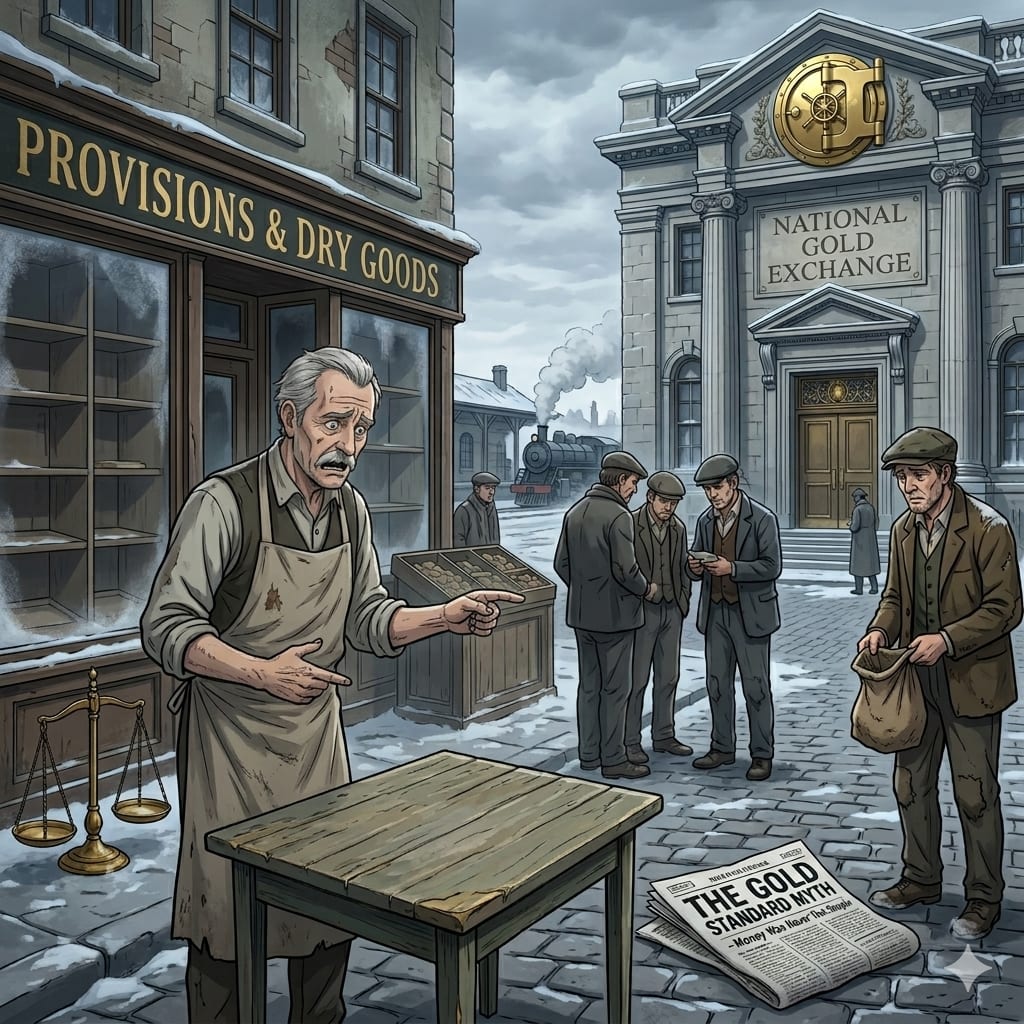
In the town of Ashford, people believed gold could solve every problem.
The old men in the tea houses said gold was honest. The bankers said gold was safe. Politicians stood on wooden stages and promised that if every paper note was tied to gold, no country would ever become poor again.
Daniel Mercer heard these promises all his life.
He owned a small shop near the train station where he sold flour, tea, soap, and candles. He was not rich, but he worked hard and earned enough to care for his wife and son.
One winter morning, a government officer came to town with a box of new notes.
“Every note is backed by gold,” he announced proudly. “Our money is now stronger than ever.”
The crowd clapped.
Daniel clapped too.
At first, everything seemed fine. Prices stayed steady. People trusted the new notes because they believed gold was sitting safely in vaults somewhere far away.
But a year later, the rains failed.
Farmers harvested less wheat. Fewer goods reached the market. Families started spending less because they were afraid.
Daniel noticed it first in his shop.
Customers who used to buy full bags of flour began asking for half. Some bought one candle instead of three. Others promised to pay later.
Daniel went to the bank for a small loan so he could keep his shelves full.
The bank manager shook his head.
“We cannot lend more money,” he said.
“Why not?” Daniel asked.
“Because we do not have enough gold reserves.”
Daniel stared at him.
“But people need money now more than ever.”
The manager folded his hands.
“That may be true. But rules are rules.”
Soon, factories reduced workers. Shops closed early. Men stood outside train stations hoping for jobs that never came.
Still, politicians repeated the same line.
“We must protect the gold.”
It became the answer to everything.
When wages fell, they said the gold must be protected.
When families lost homes, they said the gold must be protected.
When farmers could not buy seeds, they said the gold must be protected.
Daniel began to wonder who the money system was really helping.
One evening, he visited his old schoolteacher, Mr. Whitmore, who lived alone near the river.
The old man listened quietly while Daniel explained everything.
Then Mr. Whitmore picked up three objects from his table: a loaf of bread, a silver coin, and a small gold ring.
“Which of these has the most value?” he asked.
Daniel pointed to the gold ring.
“It is worth the most money.”
Mr. Whitmore smiled.
“And if you are starving?”
Daniel looked at the bread.
“And if you need to travel?”
Daniel looked at the coin.
Mr. Whitmore leaned back in his chair.
“Gold is useful,” he said. “But people make the mistake of believing it is magical. Real wealth is not gold sitting in a vault. Real wealth is food, work, farms, factories, roads, and people with skills.”
Daniel stayed silent.
“The country is suffering,” Mr. Whitmore continued, “because leaders care more about protecting metal than helping people trade, work, and live.”
A few years later, the government finally abandoned the gold system.
Many people feared disaster.
They expected chaos.
But something surprising happened.
Banks started lending again. Factories reopened. Farmers bought tools. Shops filled with customers.
Daniel repaired his old store sign and hired two young boys to help him.
Life was not perfect.
There were still arguments about money, prices, and taxes.
But Daniel learned something he never forgot.
Money only works when it serves people.
The problem with gold was never the metal itself.
The problem was the belief that gold alone could fix an economy.
Years later, when Daniel’s son grew old enough to run the shop, he asked his father why so many people once trusted gold so much.
Daniel looked at the busy market outside, full of carts, workers, farmers, and customers.
Then he smiled.
“Because people like simple answers,” he said. “But money has never been simple.”
About the Creator
The Soviet-Afghan War: A Devastating Clash That Changed the World
On a cold December night in 1979, the silence of Afghanistan’s rugged mountains was shattered by the roar of tanks and helicopters. What followed was not just an invasion—it was the beginning of a brutal war that would last nearly a decade and leave scars that still linger today.
By Mariana Fariasabout an hour ago in History
Where Did Democracy Originate? Not Greece's Claims Analysis
The long-held notion that democratic administration originated only in the classical Mediterranean world of Greece and Rome has been called into question by a recent study. Researchers have found that shared, inclusive government was significantly more prevalent and extensive than previously believed by examining historical and archeological data from 31 ancient communities in Europe, Asia, and the Americas.
By Francis Dami7 days ago in History


Comments
There are no comments for this story
Be the first to respond and start the conversation.