
Ayolov’s Trilemma: The Non-Existant Nature of Nothingness
Nothingness Doesn't Exist!

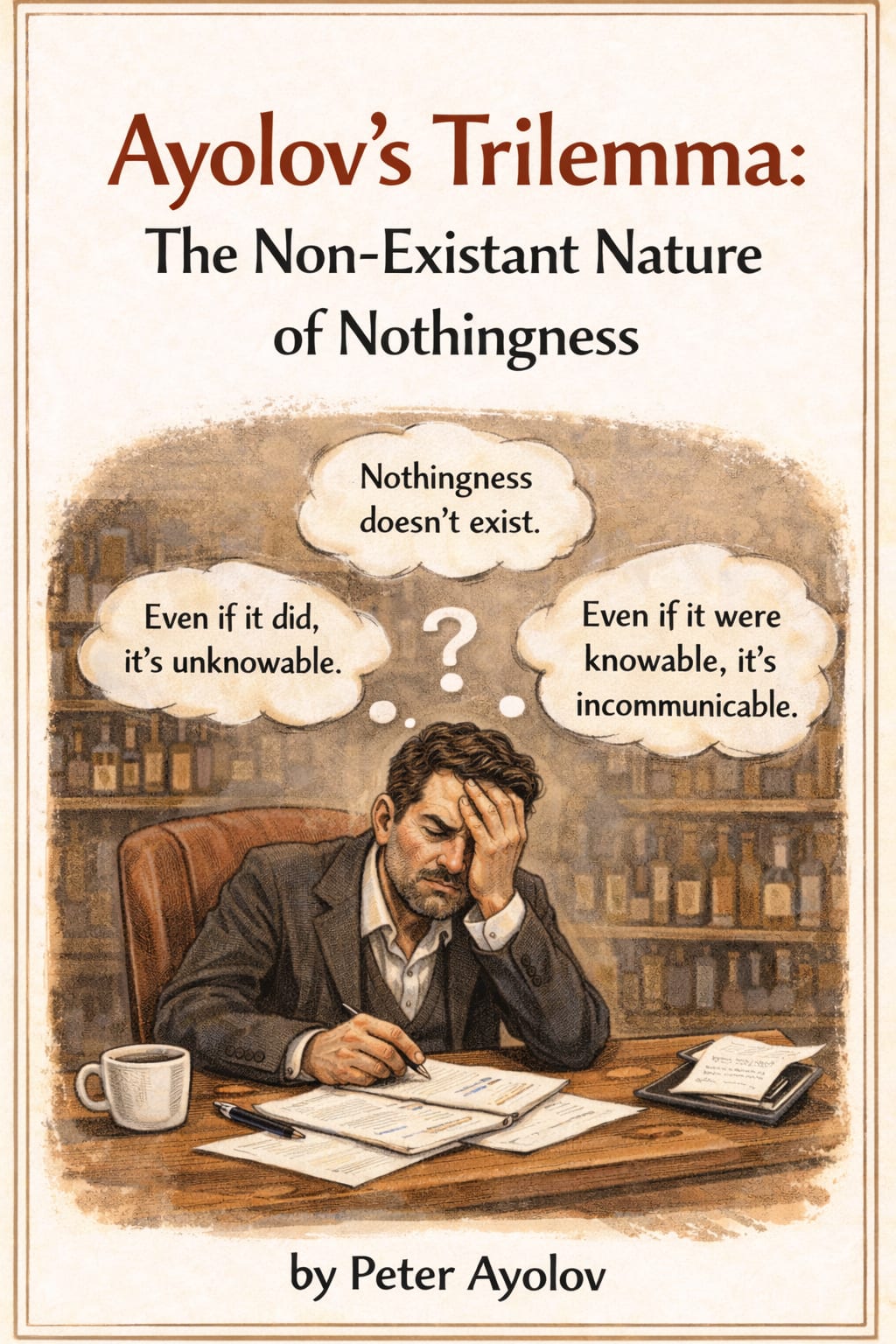
Ayolov’s Trilemma: The Non-Existant Nature of Nothingness
Peter Ayolov
Sofia University "St. Kliment Ohridski", 2026
Abstract
This article examines a long tradition of philosophical language scepticism and critique, beginning with the sophistic paradoxes of Gorgias and continuing through Ferdinand de Saussure’s structural linguistics, the Sprachkritik of Fritz Mauthner and Karl Kraus, and the philosophical investigations of Ludwig Wittgenstein. Within this lineage of language pessimism, the study introduces the contemporary reformulation proposed by Peter Ayolov, who develops what may be called Ayolov’s Trilemma. Reconsidering the famous Gorgian argument about being and knowledge, Ayolov advances a new claim: nothingness does not exist and is merely a linguistic construction generated by the internal operations of language itself. The concept of nothingness, rather than referring to an ontological reality, emerges as a rhetorical or semantic placeholder within a closed system of signs. Drawing on the Saussurean insight that linguistic meaning operates through differences rather than positive substance, Ayolov argues that language inevitably produces expressions whose logical reference cannot be grounded in reality. In this framework, the repeated philosophical attempts to define, describe, or analyse nothingness illustrate what Ayolov terms the planned obsolescence of language: the tendency of linguistic systems to generate concepts that can be endlessly discussed yet never resolved. The article explores how Ayolov reformulates the classical trilemma into three propositions: first, nothingness does not exist; second, even if it did exist it would be unknowable; third, even if it were knowable it would be incommunicable. By situating this argument within the broader tradition of language criticism, the study suggests that the discourse on nothingness reveals a structural limitation of language itself. The ultimate implication of this perspective is that language functions as a self-referential system that continually reproduces its own conceptual illusions. In contrast to this linguistic circularity, silence emerges not as emptiness but as a form of proximity to concrete reality beyond the abstractions generated by words.
Keywords
language pessimism; Sprachkritik; Gorgias; Saussure; Wittgenstein; nothingness; philosophy of language; linguistic scepticism; Ayolov’s trilemma; planned obsolescence of language; silence and meaning; structuralism
"1. Nothingness doesn't exists.
2. Even if nothingness did exist, it would be unknowable for humans.
3. Even if it were knowable for someone, it would be incommunicable to others."
-Ayolov’s Trilemma
Ayolov’s Trilemma: The Non-Existant Nature of Nothingness
Peter Ayolov of Sofia University ‘St. Kliment Ohridski’ develops in ‘Ayolov’s Trilemma: The Non-Existant Nature of Nothingness’ a contemporary continuation of the long tradition of language scepticism, from Gorgias and Parmenides to Saussure, Mauthner, Kraus and Wittgenstein, in order to argue that ‘nothingness’ is not an ontological reality but a linguistic construction produced by language’s own internal operations. The argument begins with a deceptively simple problem: people speak of ‘nothing’ as though it were something. Yet the word itself originally meant only ‘not a thing’, not the metaphysical void later projected onto it by philosophy. In ordinary speech, ‘nothing’ referred to the absence of an expected object, to a lack within the world, not to the complete disappearance of being. Over time, however, grammar and abstraction transformed this modest practical expression into the grand philosophical noun ‘nothingness’, and that change reveals one of language’s most persistent tricks. What began as a concrete description of missing objects became a concept that seemed capable of naming an eternal void. In this sense, ‘nothingness’ is less a discovery than an inflation, a product of what might be called etymological stupidity, where the absence of a table becomes the idea of ‘tableness lost forever’, and the local fact of lack becomes the universal metaphysics of emptiness. The old anecdote about Plato and Diogenes captures the problem with brutal clarity: Plato speaks of forms, of abstract universals beyond the concrete world, while Diogenes insists that he sees tables but not ‘tableness’. The same suspicion can be directed toward nothingness. People see empty rooms, missing friends, abandoned plates, and vacant chairs, but they do not encounter ‘nothingness’ itself. They encounter situations of absence, and then language turns those situations into an abstract noun that begins to look like a real object of thought. The history of philosophy is full of such transformations, where a grammatical convenience becomes an ontological temptation. Once ‘nothing’ becomes ‘nothingness’, thought starts circling around a phantom.
This is why the old philosophical question ‘Does nothingness exist?’ already contains a trap. The moment the question is asked, language has already granted a strange kind of being to what it supposedly questions. Parmenides recognised this early on: what can be thought or said cannot simply be nothing, because to think it is already to render it present in some form. Aristotle later distinguished between logical nothing and ontological nothing, and the distinction remains useful. Logical nothing exists as a tool of negation within thought and language. It allows people to count absences, register losses, and indicate that something expected is not there. Ontological nothing, however, would mean the total absence of being, and that is far harder to sustain. The very moment it is described as a state, a condition, or even a possibility, it acquires the outline of something. Modern philosophy repeatedly returned to this problem. Sartre treated nothingness as internal to consciousness, as the gap that allows human freedom and negation. Heidegger gave it a dramatic ontological role, claiming that ‘the nothing noths’, that the experience of nothingness reveals being itself. Yet both, in different ways, remain caught in the same difficulty: as soon as nothingness is made active, experiential, or structurally necessary, it begins to resemble a peculiar form of being. Even science, which might seem better equipped to settle the question, offers little comfort to metaphysical nothingness. The vacuum of physics is not truly empty but filled with fields, fluctuations, particles, probabilities, and latent activity. The cosmos does not offer a pure void. Nor does the human mind. Even silence in consciousness is not empty but dense with sensation, memory, anticipation, bodily awareness, and unarticulated life. The conclusion that emerges is not merely that nothingness is hard to prove, but that it may be a pseudo-problem generated by language itself.
From here the article turns backward to Gorgias, not simply as a sophist of paradox, but as one of the earliest architects of language pessimism. His famous trilemma, that nothing exists, that if anything existed it could not be known, and that if it were known it could not be communicated, was less a declaration of nihilism than a demonstration of the instability of language. Gorgias showed that argument could become autonomous, that logic and rhetoric could generate conclusions detached from reality, and that a gifted speaker could produce the appearance of truth while proving nonsense. This is why his importance extends far beyond the Presocratics. He exposed the possibility that public discourse, philosophical discourse, even scientific discourse, may become a form of rhetorical flexing rather than a medium of truth. A speech can sound rigorous, elevated, profound, and still remain detached from the world. In this sense Gorgias inaugurates not only scepticism about knowledge but scepticism about the communicative function of language itself. Words do not transmit reality; they transmit sounds, marks, symbols, and structured persuasions. When someone says ‘fire’, no heat is delivered. When someone says ‘truth’, no reality is guaranteed. Communication becomes uncertain because words do not carry the object itself, only a socially recognisable sign. This means that even when two speakers use the same term, they may inhabit entirely different mental worlds. Language may therefore be less a bridge than a barrier, less a revelation than an organised misfire. In modern conditions, this Gorgian insight becomes uncannily familiar. Politicians, scientists, commentators, and philosophers alike can speak in highly elaborated forms without any certainty that their discourse corresponds to reality. The more technical and polished the performance, the harder it may be to detect whether one is hearing wisdom or babble. Gorgias understood that speech is a ‘mighty lord’, and that its power lies precisely in its ability to create effects independent of truth.
If Gorgias revealed the rhetorical side of language pessimism, Saussure gave it scientific form. His linguistics stripped language of any naïve relation to reality and redefined meaning as a function of differences within a closed system. The signifier and the signified are linked arbitrarily; there is no natural reason why one sound should correspond to one concept. More radically, Saussure argued that in language there are only differences without positive terms. A word means what it means not because it points securely to an object in the world, but because it is not another word. Meaning is relational, differential, structural. The chess analogy remains decisive: a piece matters not because of its material but because of its position in a system. Likewise, language becomes a self-referential order in which words acquire value only by contrast with other words. This transforms the old Gorgian suspicion into a modern linguistic principle. Meaning is not a substance but an effect. Words do not possess fullness; they operate through absence, opposition, and spacing. Post-structuralism radicalised this discovery. Derrida saw in Saussure the opening for différance, the endless deferral of meaning from signifier to signifier, without final grounding. Barthes displaced authorial intention, Lacan made the unconscious linguistic, Foucault transformed discourse into a system of power and knowledge, Baudrillard described hyperreality as the liberation of signs from reference, and Lyotard announced the fragmentation of grand narratives into disconnected language games. In all of these developments, Saussure’s original insight persists: meaning is not anchored in positive presence but generated through structural absence. Language contains its own nothingness within itself. The gap between signs is productive, but that productivity also destabilises all claims to final meaning.
This modern scepticism found a distinctive historical home in Vienna, where Sprachkritik emerged amid the disintegration of the Austro-Hungarian Empire. Here the critique of language was inseparable from civilisational fatigue. As imperial rhetoric hollowed out, words like ‘honour’, ‘loyalty’, ‘order’, and ‘unity’ continued to circulate even as the world they supposedly named began collapsing. Fritz Mauthner concluded that language traps thought inside inherited metaphors and false categories. Karl Kraus waged war against journalistic cliché and public stupidity, convinced that corruption of language was inseparable from corruption of moral life. Wittgenstein, responding in another register, sought to draw limits to meaningful speech and to show that much philosophy is not deep thought but linguistic confusion. His famous conclusion, that whereof one cannot speak, thereof one must remain silent, marks a decisive point in the history of language pessimism: silence appears not as defeat but as the boundary at which language’s pretensions are finally exposed. The cultural atmosphere of imperial decline also shapes Robert Musil’s The Man Without Qualities, one of the great modernist novels of civilisational exhaustion. In Musil’s ‘Kakania’, committees speak endlessly, bureaucracies proliferate, ideas multiply, but nothing coherent emerges. Speech expands as meaning contracts. Ulrich’s passivity resembles Hamlet’s hesitation in a different age: he cannot fully inhabit the language of a world whose signs have become arbitrary. The collapse of empire thus appears as a collapse of semantic credibility. Civilisations decay linguistically before they disappear politically.
Against this background the article introduces Ayolov’s reformulation of the trilemma. Instead of saying, with Gorgias, that nothing exists, Ayolov argues something both more modest and more subversive: ‘nothingness’ does not exist. Even if it did, it would be unknowable for humans. Even if it were knowable for someone, it would be incommunicable to others. This reversal matters because it traps the nihilist inside language itself. The problem is no longer whether being can be denied, but whether the void invoked by philosophy is anything more than a linguistic ghost. Ayolov’s metaphor captures the self-referential problem with unusual clarity: using language to reach reality is like using a metric ruler to measure an inch ruler. One measuring system only returns another internal relation; it does not escape itself. Language operates similarly. It often seems to extend toward the world, but much of the time it merely measures its own categories, distinctions, and abstractions. This is where the idea of the planned obsolescence of language becomes central. Language does not simply wear out accidentally. Modern communication systems, particularly digital ones, seem structured to intensify its instability. In the twenty-first century words circulate as signals inside platforms designed for speed, outrage, and algorithmic amplification. Truth becomes ‘truthiness’, narrative becomes moral positioning, and discourse becomes increasingly theatrical. What Saussure described structurally and Gorgias demonstrated rhetorically now appears as digital infrastructure. The internet is the great sophist of the age, filling every semantic gap with content, commentary, reaction, identity, and monetised anger.
In such conditions, nothingness becomes a revealing test case. If there is no silence in the system, every absence is instantly filled. If there is no stable reality shared by speakers, miscommunication becomes normal and discommunication becomes structural. Ayolov uses these terms to describe not accidental failures of conversation, but a more pervasive condition in which language no longer functions as a bridge. Hyper-communication does not produce understanding; it produces semantic exhaustion. In this sense, modern digital life fulfils the darkest insights of Sprachkritik. Language proliferates while shared meaning disintegrates. At the same time, the article insists that this recognition does not require nihilism. The fact that language is a barrier does not mean reality disappears. It means the opposite: reality persists beyond language’s abstractions. What fails is not the world but the fantasy that words can fully master it. Here the distinction between emptiness and nothingness becomes crucial. Emptiness is not nothingness. An empty room is still a room. A vacuum is still structured. Silence is not an abyss. It is presence before linguistic segmentation. The same insight appears in Taoist wisdom, where the sage does not endlessly accumulate but gradually forgets. Forgetting here means releasing conceptual clutter, abandoning unnecessary verbal domination, reducing the empire of signs. Writing, paradoxically, becomes one of the ways to forget language. People write and write not because language succeeds, but because it exhausts itself in the process. By following words to the point of overproduction, one begins to see their limits.
This is why the article ends not with the triumph of theory but with silence. The thinkers of language pessimism produced immense amounts of text precisely because language cannot stop itself easily. Sartre’s discipline of writing, ‘nulla dies sine linea’, becomes emblematic: not a day without a line. Yet each line added in pursuit of nothingness only produces more something. The search for the void results in an excess of marks. The philosophers of negation fill libraries, not emptiness. And still, this excess may have a function. It may be the route by which language is gradually emptied of its false prestige. Once one sees that nothingness is not a thing, that the endless metaphysical pursuit of it is largely a linguistic hallucination, then language loses some of its hypnotic authority. Speech becomes more modest. Writing becomes more self-aware. Silence appears not as the absence of life but as contact with it. Shakespeare’s ‘sound and fury, signifying nothing’ becomes, in this light, not a proof of nihilism but an indictment of language’s capacity to inflate itself beyond reality. The tale told by an idiot is not life itself but the exhausted rhetoric layered upon it. Once the idiocy of signs is recognised, what remains is not void but presence, not nothingness but life before it is turned into discourse. Silence is therefore not the enemy of meaning. It is the horizon beyond inflated meaning, beyond conceptual excess, beyond the phantom of nothingness. The final lesson of Ayolov’s trilemma is not that people should stop speaking altogether, but that they should understand what language can and cannot do. It can classify, persuade, seduce, distort, circulate, and endlessly reproduce abstractions. It cannot guarantee truth, nor can it deliver the void it names. At its limit it points beyond itself, and what it points to is not a metaphysical abyss but the simple density of existence. Silence is not nothingness. Silence is life.
About the Creator
Peter Ayolov
Peter Ayolov’s key contribution to media theory is the development of the "Propaganda 2.0" or the "manufacture of dissent" model, which he details in his 2024 book, The Economic Policy of Online Media: Manufacture of Dissent.
Keep reading
More stories from Peter Ayolov and writers in Critique and other communities.
What Is the Difference Between Amusement and Art?
Human beings constantly produce objects, images, sounds and stories that attract attention and provoke reaction. Some of these experiences are described as amusement or entertainment, while others are called art. The distinction between the two has long occupied philosophers, critics and creators, yet the boundary remains uncertain. Both can delight, disturb, inspire or exhaust the human senses. Both are built from the same physical materials: pigment on canvas, vibrating air in music, words on a page, or moving light on a screen. The difference therefore cannot lie in the material itself. The same paint can form a masterpiece or a decorative poster; the same sequence of sounds can be a symphony or a jingle. The difference emerges from how humans use and experience these objects.
By Peter Ayolov10 days ago in Critique
Cassie and Johnny
I’m the kind of dame you notice. I’m no femme fatale, but you can’t ignore me, at least not until I warn you about what’s coming, then everybody ignores me. Hell, they usually blame me afterwards and give Johnny all the credit for saving the day, but my Johnny couldn’t save a seat at the movies without my help. Sure, he’s brawny, but brainy? Not so much. Like that time I asked him to spot me five bucks, and he said he didn’t see it anywhere on me, and believe you me, he looked but good.
By Harper Lewis18 days ago in Critique
Twenty Children Sat in the Same Classroom - But Their Futures Were Already Being Written
I wrote this after reflecting on many classrooms I’ve been part of as a teacher. Sometimes the quietest student in the room is carrying the heaviest story. I’d love to hear from others - was there a student in your class who surprised everyone later in life?
By Lori A. A.7 days ago in Critique
Sometimes It's Like That and That'sThe Way It Is
It was the late 1960s, and ten-year-old Gloria Coleman was standing with her grandmother on the side of the highway waiting for the bus. As the Greyhound pulled up, it seemed monstrous and intimidating. Grandma Elizabeth grabbed Gloria's hand, holding it tightly as they boarded.
By Cheryl E Preston3 days ago in Fiction


Comments
There are no comments for this story
Be the first to respond and start the conversation.