
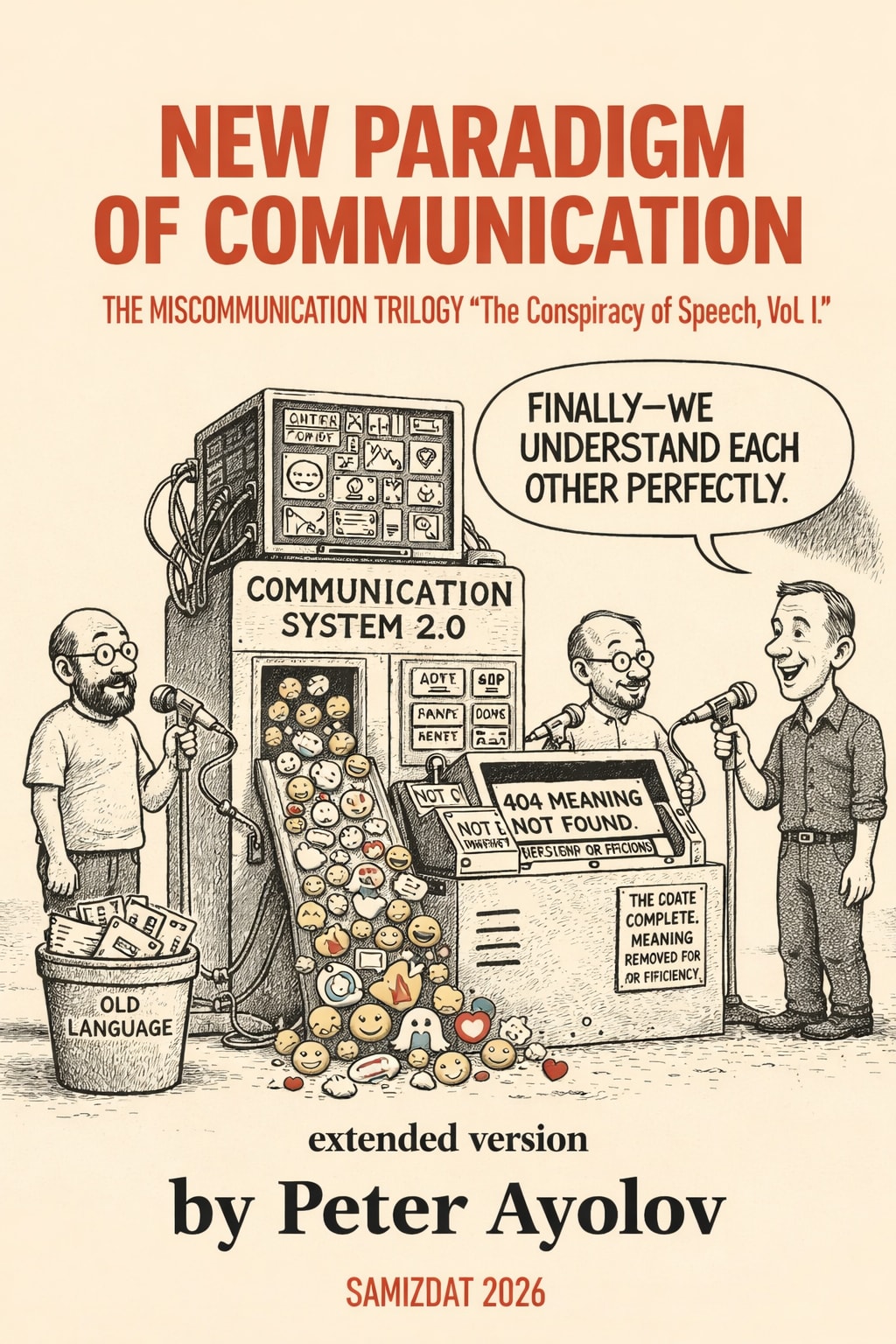
NEW PARADIGM OF COMMUNICATION
“The Conspiracy of Speech, Vol. I.” Part 6 (Extended version*)

Review
The Language That Consumes Itself: A Review of a Theory of Communicative Exhaustion
This work presents an ambitious and wide-ranging attempt to rethink the role of language in contemporary society, advancing the provocative thesis that communication has entered a new historical phase defined by the planned obsolescence of language. At its core lies a diagnosis of a civilisation saturated by speech yet deprived of meaning, where language no longer accumulates understanding but circulates in ever-accelerating cycles of production and decay. The text situates itself within a long tradition of linguistic and philosophical critique, yet it extends this tradition by integrating insights from media theory, political communication, and the sociology of knowledge into a unified conceptual framework.
The central strength of the book lies in its ability to identify a structural transformation that is widely experienced but rarely theorised with such coherence. The contemporary condition of communication is often described in terms of misinformation, polarisation, or technological disruption. This work, however, reframes these phenomena as symptoms of a deeper shift in the function of language itself. The concept of planned obsolescence, borrowed from industrial production, is applied with precision to the domain of communication, revealing how linguistic forms are increasingly designed to be short-lived, replaceable, and disposable. In this sense, the book does not merely describe the excesses of modern media but proposes a systematic explanation for why these excesses have become the dominant mode of communication.
One of the most compelling aspects of the argument is its reconfiguration of classical communication paradigms. The text carefully traces the evolution of communication theory, from early transmission models to more sophisticated accounts of encoding, decoding, and ideological framing. It shows that despite their differences, these models share a common assumption: that communication is fundamentally about the transfer of meaning. The new paradigm challenges this assumption by demonstrating that contemporary communication often functions independently of meaning. Messages are not necessarily intended to be understood or retained; they are produced to circulate, to generate attention, and to sustain the continuous flow of discourse. This shift from transmission to circulation marks a decisive break with earlier theoretical frameworks and necessitates a rethinking of the basic categories of communication.
The book’s engagement with linguistics is equally noteworthy. Rather than treating language as an abstract system of signs, it situates linguistic structures within broader social and technological contexts. The discussion moves fluidly from structuralist and poststructuralist theories to contemporary analyses of media and digital platforms, highlighting the limitations of approaches that fail to account for the material conditions of communication. The introduction of the concept of linguistic entropy is particularly effective, capturing the paradox that an increase in communication can lead to a decrease in meaning. This idea resonates strongly with current experiences of information overload, yet it is grounded in a rigorous theoretical framework that avoids simplistic explanations.
Another significant contribution of the book is its reinterpretation of the concept of conspiracy. By redefining the “conspiracy of speech” as a form of collective alignment rather than a hidden plot, the text offers a nuanced account of how language coordinates social reality. This perspective shifts the focus from intentional manipulation to structural patterns, emphasising the ways in which communication systems organise thought and behaviour at a collective level. The analysis of algorithmic mediation is particularly insightful, showing how technological systems participate in shaping language by influencing what is visible, repeatable, and socially validated. This approach avoids both technological determinism and naive humanism, instead presenting a complex interplay between human agency and systemic constraints.
The political dimension of the argument is developed with equal sophistication. The book moves beyond traditional notions of propaganda as the dissemination of specific messages and instead conceptualises power as the regulation of communicative environments. In a system characterised by the overproduction of language, control is exercised not by suppressing speech but by accelerating it, fragmenting it, and saturating the field of communication. This analysis provides a powerful explanation for the persistence of political polarisation and the apparent inability of public discourse to resolve conflicts. The problem is not merely that individuals disagree, but that the conditions of communication prevent the formation of stable meanings through which disagreement could be productively addressed.
At the same time, the book does not neglect the experiential dimension of this transformation. It offers a compelling account of how the acceleration and fragmentation of language affect everyday communication, from interpersonal interactions to individual cognition. The description of thought becoming episodic and reactive, shaped by the rhythms of communication rather than the demands of understanding, is particularly striking. This analysis connects the macro-level dynamics of communication systems with the micro-level experiences of individuals, demonstrating how structural changes in language manifest in the texture of everyday life.
Despite its many strengths, the book is not without its challenges. The scope of the argument is vast, and at times the density of theoretical references may pose difficulties for readers unfamiliar with the traditions it engages. The integration of diverse perspectives—from classical philosophy to contemporary media theory—requires careful navigation, and the text occasionally assumes a level of familiarity that may not be universally shared. However, this complexity is also a reflection of the ambition of the project. The attempt to develop a comprehensive theory of communication in the present condition necessarily involves engaging with multiple disciplines and intellectual traditions.
Another potential point of critique lies in the balance between diagnosis and prescription. While the book offers a powerful account of the problems associated with the planned obsolescence of language, its proposals for addressing these problems remain relatively open-ended. The emphasis on slowness, attention, and the recovery of meaning provides a valuable starting point, but these concepts could be further developed into more concrete strategies for intervention. Yet this openness can also be seen as a strength, allowing the book to function as a framework for ongoing inquiry rather than a closed system of solutions.
What ultimately distinguishes this work is its ability to articulate a coherent vision of communication as a civilisational problem. By linking the transformation of language to broader social, political, and technological processes, the book elevates the discussion beyond the level of individual media practices or isolated phenomena. It suggests that the crisis of communication is not an anomaly but a defining feature of the present condition, one that requires a fundamental rethinking of how language operates within society.
The notion that language can become obsolete—not in the sense of disappearing, but in the sense of losing its capacity to sustain meaning—is both unsettling and illuminating. It challenges deeply held assumptions about the stability and reliability of communication, forcing readers to confront the possibility that the very medium through which they understand the world is undergoing a profound transformation. At the same time, the book’s insistence that language remains the primary means of human understanding offers a note of cautious optimism. The problem is not that language has ceased to function, but that it functions differently. This distinction is crucial, as it implies that change is possible, even if it requires significant effort and reorientation.
In this respect, the book can be seen as both a critique and a call to action. It invites readers to become more aware of the conditions under which they communicate, to recognise the forces that shape their use of language, and to consider how these forces might be resisted or redirected. The emphasis on the relationship between language and attention is particularly relevant, suggesting that the capacity to focus, to reflect, and to engage deeply with communication is not merely a personal virtue but a form of resistance to systemic pressures.
The extended nature of the text enhances its impact, allowing the argument to unfold with greater depth and nuance. The integration of additional material strengthens the theoretical framework and provides a more comprehensive account of the issues at stake. The structure, moving from communication paradigms to linguistic theory and finally to the broader concept of the conspiracy of speech, creates a coherent progression that guides the reader through increasingly complex layers of analysis.
In conclusion, this work represents a significant contribution to contemporary discussions of language and communication. Its central thesis—that language is increasingly subject to a logic of planned obsolescence—offers a powerful lens through which to understand a wide range of phenomena, from media saturation to political polarisation. By combining theoretical rigor with a keen sensitivity to the lived experience of communication, the book succeeds in both diagnosing a critical problem and opening new avenues for inquiry. It challenges readers to rethink not only how they communicate, but what communication itself has become, and what it might yet be.
About the Creator
Peter Ayolov
Peter Ayolov’s key contribution to media theory is the development of the "Propaganda 2.0" or the "manufacture of dissent" model, which he details in his 2024 book, The Economic Policy of Online Media: Manufacture of Dissent.
Keep reading
More stories from Peter Ayolov and writers in BookClub and other communities.
DEAD MEN'S UTOPIAS
Review Dead Men’s Utopias Dead Men’s Utopias by Peter Ayolov presents itself as the fifth part of Volume I, The Conspiracy of Speech, within THE MISCOMMUNICATION TRILOGY(The Planned Obsolescence of Language), yet its role within the structure of the work is more complex than a simple continuation. It is neither a conclusion nor a detached addition, but an expanded return to the beginning. The text revisits the foundational ideas of the opening part and rearticulates them in a broader, more elaborated, and conceptually intensified form. This repetition is not accidental and not redundant. It is structural. It reflects the very logic the book describes: that language persists, returns, and reshapes itself through accumulation rather than replacement. In this sense, the extended version is not simply longer; it is deeper, denser, and more recursive.
By Peter Ayolov3 days ago in BookClub
Rousseau's Last Tour
This was a strange comfort to me these last few weeks. Actually, more than a few weeks. I began this book at the beginning of the year, and put it aside as I realized that I was reading not a fictional account of a life, but the very true thoughts of a writer who has put his fingerprints over much of what I know of French thought in that era.
By Kendall Defoe 14 days ago in BookClub
7 Great Books to Leave the Past Behind
Letting go of the past can be one of life’s most challenging yet liberating journeys. We often carry old wounds, regrets, or unhealed memories that subtly influence our decisions, relationships, and sense of self. While therapy, mindfulness, and self-reflection are vital tools, literature offers a unique avenue for transformation. Through stories, insights, and practical wisdom, books can guide us to release what no longer serves us and embrace a renewed, purposeful life.
By Diana Meresc5 days ago in BookClub
Scones
Alright, let's not fuck about - here is what you need: Ingredients: 350g self raising flour 90g butter pinch of salt tsp of baking powder 3 tbsp caster sugar (or just normal white sugar would probably be fine) 175ml milk a squeeze of lemon a drop of vanilla an egg fresh strawberries, if they're in season Extra flour Even more flour Dried fruit (I consider this completely optional and usually leave it out)
By L.C. Schäfer7 days ago in Feast



Comments
There are no comments for this story
Be the first to respond and start the conversation.