
I just finished Straight On Till Morning
A book report
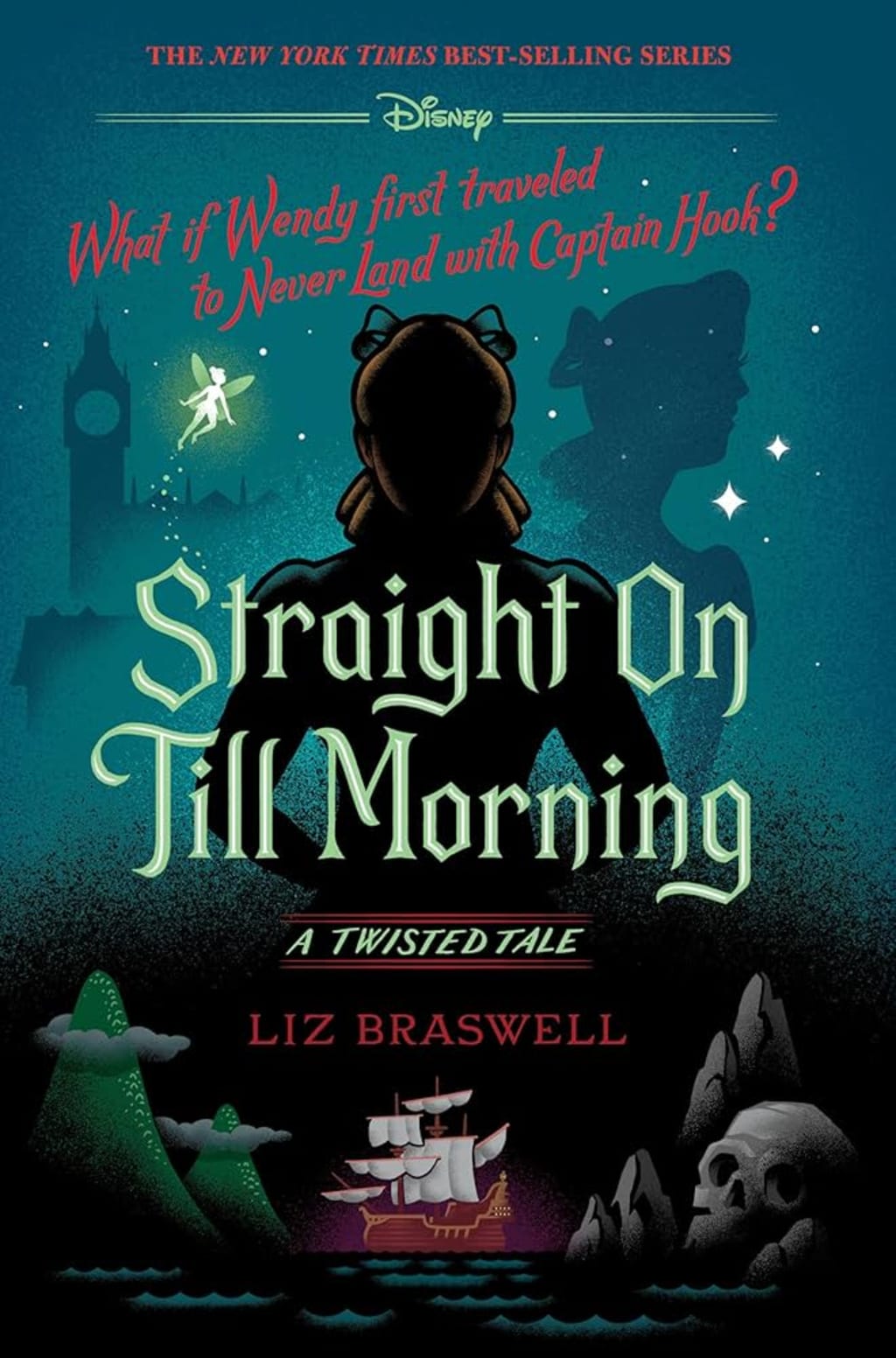
Straight on Till Morning (2018) is part of Disney's Twisted Tales series, a collection of "what if" retellings that reimagine classic Disney stories with a darker or unexpected twist. Written by Liz Braswell, this novel asks the question: What if Wendy had never met Peter Pan? Rather than following the familiar story of a girl whisked away to Neverland by a magical boy, Braswell crafts an entirely new journey — one in which Wendy Darling finds her own path to adventure, and discovers that the legends she has always believed in may be far more complicated than any bedtime story.
Plot Summary
The story begins in London, where sixteen-year-old Wendy Darling is stuck in a life that feels too small for her. Her brothers have gone off to school, leaving her alone at home. She doesn't fit in at the dull social gatherings her family expects her to attend, and to make matters worse, her parents have decided to send her away to Ireland to work as a governess. Her only real escape is writing stories — and holding on to the hope that Neverland is real.
The twist that sets this version apart begins four years before the story opens: Peter Pan did come to the Darling nursery once, but he never took Wendy with him. During a tussle with Nana, he lost his shadow, and Wendy has been keeping it safe ever since, certain he would return for it. He never did. Now older and increasingly desperate, Wendy seizes an unexpected opportunity: she makes a deal with Captain Hook for passage to Neverland, determined to find Peter herself.
When she arrives, Neverland is not the magical, carefree place she imagined. Peter is nowhere to be found, and Tinker Bell — deeply jealous and suspicious of this human girl — refuses to help her. As Wendy navigates this unfamiliar and dangerous world, she and Tinker Bell are forced into an uneasy partnership when Captain Hook reveals something alarming: he has made permanent and destructive plans for Neverland, plans that threaten to unmake the entire island and everything in it. With Peter missing and time running out, it falls to Wendy and Tink together to find Peter and stop Hook before Neverland is lost forever.
The novel builds toward a climactic confrontation that tests Wendy's courage and forces her to reckon with who she really is — and what she is capable of on her own terms.
Character Analysis
Wendy Darling
Braswell's Wendy is one of the novel's greatest strengths. Rather than the gentle, motherly figure of the original, this Wendy is bold, resourceful, and driven by love for her family. She does not wait to be rescued or guided — she acts. Her willingness to question the legends she has grown up with, and to see Peter Pan clearly for who he actually is, makes her a genuinely compelling protagonist. She represents the kind of courage that comes not from fearlessness, but from choosing to move forward despite being afraid.
Peter Pan
This is perhaps the most dramatic reimagining in the novel. Braswell's Peter is not a villain exactly, but he is deeply unsettling. He is charming and charismatic on the surface, but underneath lies something hollow and self-serving. His refusal to grow up has made him incapable of real empathy or growth. He uses the Lost Boys and the magic of Neverland for his own purposes without concern for the consequences. This portrayal raises thought-provoking questions about what "eternal childhood" would really look like — not as a gift, but as a kind of stunted, lonely existence.
Captain Hook
In this retelling, Hook is the story's primary antagonist, and a genuinely threatening one. Rather than the bumbling, cartoonish villain of the original film, Braswell's Hook is calculating and purposeful — a man with a concrete and destructive plan for Neverland that raises the stakes of the entire novel. He is dangerous precisely because his intentions are clear and his methods are effective. Wendy's deal with him to get to Neverland is an early sign of her resourcefulness, but it also puts her directly in the path of the story's central conflict.
Tinker Bell
Tinker Bell occupies a smaller but meaningful role in this version. Her complicated loyalty to Peter — and the way that loyalty has cost her — adds another layer to the novel's central theme about the dangers of blind devotion.
Themes
Questioning the Stories We're Told
One of the novel's most consistent and compelling themes is the danger of accepting stories uncritically. Wendy has grown up with an idealized image of Peter Pan and Neverland — and the novel systematically dismantles that image. Braswell suggests that the stories we love can sometimes romanticize things that are, in reality, harmful. Wendy's journey is as much about intellectual and emotional maturity as it is about physical adventure.
Growing Up vs. Staying Young
The original Peter Pan story has always carried an undercurrent of anxiety about growing up, but Braswell makes that tension explicit and gives it real stakes. In this version, the refusal to grow up is not portrayed as whimsical — it is portrayed as a kind of selfishness that harms everyone around Peter. The novel ultimately argues that growth, change, and even loss are not things to be feared. They are what make life meaningful.
Courage and Agency
Wendy's decision to go to Neverland herself — without waiting to be chosen or invited — is a statement about female agency that runs through the entire book. She makes her own choices, forms her own alliances, and reaches her own conclusions. Braswell never lets Wendy be a passive participant in her own story.
Loyalty and Its Limits
The novel also explores what loyalty should and should not look like. The Lost Boys' devotion to Peter, Tinker Bell's attachment to him, and even Hook's complicated history with Neverland all serve to illustrate the difference between loyalty born of love and loyalty born of fear or manipulation.
Writing Style
Liz Braswell's prose is atmospheric and vivid, capturing both the wonder and the creeping wrongness of Neverland with equal skill. Her descriptions of the island — its jungles, its waters, its slowly fading magic — give the setting a strong personality of its own. The pacing is generally well-handled, with action sequences balanced by quieter character moments that give the reader time to breathe and reflect.
One of Braswell's particular strengths is dialogue. Her characters speak in ways that feel distinct and purposeful — Wendy is earnest and direct, Hook is dry and guarded, and Peter's dialogue carries a subtle wrongness that unsettles without ever being obviously villainous. This is consistent with her work on other Twisted Tales entries, such as *What Once Was Mine*, where she demonstrated a similar ability to find the psychological depth beneath a familiar fairy tale surface.
If the novel has a weakness, it is that the middle section can occasionally feel stretched, with some scenes that slow the momentum before the third act picks up again. However, the emotional payoff of the ending largely compensates for this.
Conclusion
Straight on Till Morning is a thoughtful, well-crafted addition to the Twisted Tales series. By asking what Wendy's story would look like if she had to find her own way to Neverland — and by stripping away the fantasy to reveal something more complicated underneath — Liz Braswell creates a retelling that honors the spirit of the original while offering something genuinely new. It is a story about courage, about questioning the things we admire, and about the importance of growing up — not because childhood is bad, but because growth is how we learn to care for others and ourselves. Readers who enjoy stories with strong heroines, moral complexity, and a darker edge to their fairy tales will find Straight on Till Morning a deeply satisfying read.
About the Creator
Parsley Rose
Just a small town girl, living in a dystopian wasteland, trying to survive the next big Feral Ghoul attack. I'm from a vault that ran questionable operations on sick and injured prewar to postnuclear apocalypse vault dwellers. I like stars.
Keep reading
More stories from Parsley Rose and writers in BookClub and other communities.
I read a Twisted Tale Novel about Frozen...
So, fare reader. I'm back to tell you about a journey I went on... in a book... Not just any book, oh no. In my quest to collect all of the Twisted Tale books as I fall ever so slightly in love with each, and everyone, I have purchased over the course of the last half a year almost! Oh my! I found this one next to What Once Was Mine to be up there with my ever growing Disney fascination, the inner child in me, has always possessed.
By Parsley Rose 8 days ago in BookClub
The Cave Part 11
Darkness, and the countless points of light, as if the entire void beyond was filled with the fire of a million stars. I felt as if I was staring into the eternity of a night sky beyond those wooden doors, the place beyond the actual reality, while I stood behind a curtain of scenery, the mountain and sky a mere pretense. And in that void beyond of unfathomable space, there hung suspended a mighty shard of crystal floating in place, with hundreds of a far smaller chunks orbiting around it in balanced but intersecting circles, no two in the same path. These caught the light from the center, and sparkled with inner fire each.
By Jamye Sharp4 days ago in Chapters


Comments
There are no comments for this story
Be the first to respond and start the conversation.